The NUANCE studies (NUrsesANdneurodivergenCE) comprise a series of scientific studies focusing on neurodiversity within the nursing profession.
Background
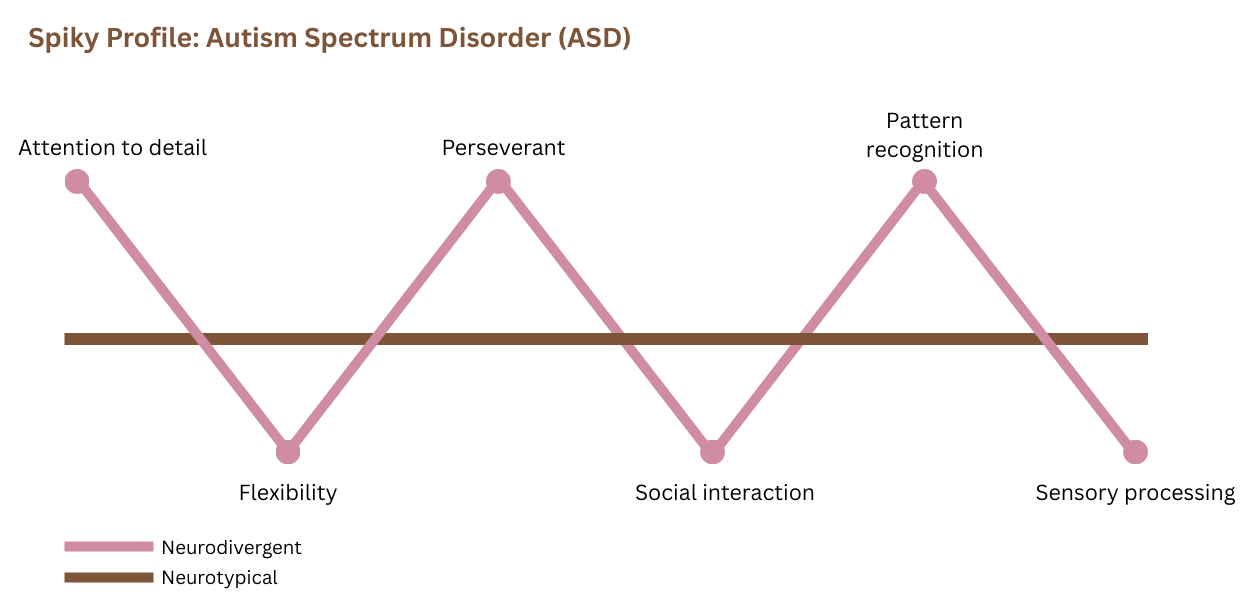
These studies arise from the growing societal recognition of neurodiversity. Both in literature and in practice, a mismatch is observed between societal systems—primarily designed around neurotypical individuals—and the needs of neurodivergent individuals in the workforce. An important explanation for this is the so‑called spiky profile: Neurodivergent individuals tend to show relatively strong cognitive peaks, where certain competencies are highly developed, while others require more effort. For example, a person with autism may have a strong eye for detail, be highly persistent, and excel at pattern recognition, while at the same time experiencing difficulties in other domains, such as cognitive flexibility, social interaction, and sensory processing. In other neurodivergent groups, such as highly sensitive individuals, different competencies are more pronounced (see examples below). Neurotypical individuals generally have a more ‘flat’ cognitive profile.
Example of autism
Example of high sensitivity

When the workplace expects the same from everyone, while each brain works differently, challenges arise. Tasks may structurally fail to align with someone’s strengths and weaknesses. As a result, neurodivergent individuals may experience difficulties related to:
- sensory processing (e.g., noise or busy environments)
- dealing with changing situations (e.g., rotating departments or work locations)
- social interactions (e.g., conversations, handling conflicts, or collaboration)
- career development (constrained by the underrecognition and underacknowledgment of individual talents)
Recognizing these challenges and creating a safe work environment with room for individualized support can significantly reduce these issues. In practice, however, the opposite often occurs: the needs and strengths of neurodivergent individuals are insufficiently acknowledged and appreciated. This can lead to stigmatization, exclusion, and the loss of valuable talent.
Gap in the literature
To date, little research has been conducted on neurodivergence within healthcare, particularly within nursing. This is notable, given that nursing places high demands on communication, empathy, planning, and flexibility—qualities that may be more challenging for some neurodivergent individuals. For this reason, the NUANCE studies focus on the following core questions:
- What is the prevalence of neurodivergence among nurses?
- How do nurses with and without neurodivergence experience their work, and how do these experiences differ?
- How do neurodivergent nurses experience their work on a deeper level, and how do they explain these experiences?
- How can challenges be better supported and strengths more effectively utilized?
The goal of our research project is to promote the sustainable employability of nurses, especially in light of current and future workforce shortages.
Study design
Because the existing literature is limited, we begin with broad, exploratory studies. The first studies focus on hospital‑based nurses, as their tasks and responsibilities differ significantly from those in other healthcare sectors.
On the homepage, you will find an overview of the research questions guiding our work. Below, you will find a summary and publication link for each completed study.
Study overview
Study 1
Development and content validation of an instrument to estimate the prevalence of neurodivergence among hospital-based nurses in the Netherlands and to explore workplace experiences of nurses with and without neurodivergence: A Delphi study.
Update (July 2026): In the final phase. The publication is currently being written. The summary will be available soon.
Study 2
Neurodivergence prevalence and experiences of hospital-based nurses in the Netherlands: A cross-sectional multicenter survey study.
Update (July 2026): Data collection is in its final stage, and early analyses are being conducted. First results are anticipated in October 2026.
Study 3
A qualitative study on the impact of neurodivergence in the nursing workplace: perspectives of neurodivergent nurses, colleagues, and managers.
Update (July 2026): the study setup has commenced and participant recruitment is underway.
Study 4
Not yet started.
Study 5
Not yet started.